

Finding damaged, discoloured or crumbling timber in your property can be worrying. One of the first questions homeowners often ask is whether they’re dealing with dry rot or wet rot.
Both are forms of fungal timber decay associated with moisture, but they’re not the same problem. They can develop differently, produce different warning signs and require the underlying source of moisture to be identified and addressed.
At North West Dry Rot LTD, we understand how important it is to correctly identify timber decay before deciding on the appropriate treatment.
So, what is the difference between dry rot and wet rot, and what signs should you be looking for?
What Is Dry Rot?
Dry rot is a type of fungal decay that attacks timber.
Despite its name, dry rot still requires moisture to become established. It doesn’t simply develop in completely dry timber.
Once conditions are suitable, the fungus can cause significant deterioration to affected wood and may spread beyond the immediately visible area.
Dry rot can sometimes remain hidden underneath floors, behind skirting boards, within wall voids or around other concealed structural timbers, making professional investigation particularly important.
What Is Wet Rot?
Wet rot is another form of fungal timber decay, generally associated with timber remaining persistently damp.
It commonly develops where there’s an ongoing source of moisture.
This could potentially include:
- Leaking plumbing
- Defective gutters
- Roof leaks
- Water ingress
- Poor ventilation
- Condensation problems
- Damp affecting timber
- External defects allowing moisture into the building
Wet rot tends to remain more closely associated with the damp conditions causing the problem.
Addressing the moisture source is therefore a crucial part of dealing with the decay.
What Does Dry Rot Look Like?
Dry rot can appear differently depending on the stage of development and conditions within the property.
Potential warning signs can include timber becoming brittle, cracked or weakened.
Affected wood may develop a distinctive pattern of cracking, sometimes breaking into roughly cube-shaped sections.
Other possible signs can include fungal growth, strands or a fruiting body.
However, homeowners shouldn’t rely on photographs from the internet to diagnose the problem.
Different types of timber decay can sometimes look similar, particularly when they’re hidden or at an early stage.
What Does Wet Rot Look Like?
Wet rot can also vary in appearance.
Depending on the type of decay and conditions, timber may become soft, weakened, discoloured or cracked.
You might notice timber that feels unusually damp or spongy, particularly around an area where moisture is entering the property.
Other affected timber can become brittle.
The important clue is often the surrounding environment.
If timber deterioration is concentrated around an obvious leak, persistent damp patch or other source of moisture, this information can help during a professional investigation.
Dry Rot vs Wet Rot – What’s the Main Difference?
Both problems involve fungal decay of timber, so the distinction isn’t simply that one is “dry” and the other is “wet”.
One of the practical differences is how the decay behaves and the conditions surrounding it.
Wet rot is generally associated with timber that remains persistently wet and tends to be more localised around the moisture source.
Dry rot can be particularly concerning because of its potential to affect timber beyond the area where the initial moisture problem occurred.
This is why correctly identifying the type and extent of decay is so important.
Where Can Timber Rot Develop?
Timber decay isn’t always somewhere obvious.
Problems may occur in areas such as:
- Floorboards
- Floor joists
- Roof timbers
- Skirting boards
- Window and door frames
- Cellars and basements
- Timber around plumbing
- Areas underneath baths and showers
- Timbers close to external walls
- Poorly ventilated voids
Sometimes the first visible warning sign appears some distance from the underlying source of moisture.
Watch for Changes in Your Floors
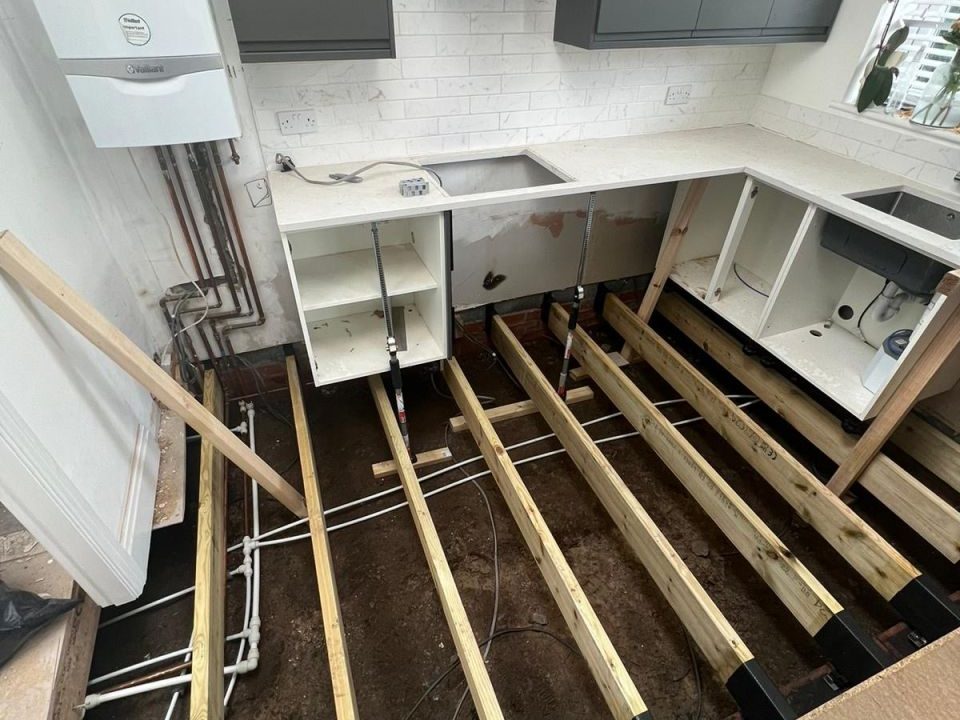
Problems underneath suspended timber floors can remain unnoticed for a considerable period.
Warning signs might include floorboards beginning to feel unusually soft, springy or unstable.
You might also notice changes around skirting boards or a persistent damp or musty smell.
If a floor suddenly feels different when walked across, don’t simply cover it with new flooring and hope the problem disappears.
The underlying timber should be investigated.
Don’t Ignore Musty or Damp Smells
A persistent damp or musty smell can be an early indication that excess moisture is present somewhere within the property.
The smell alone doesn’t confirm dry rot or wet rot.
However, if it’s accompanied by damaged timber, damp walls, fungal growth or changes in flooring, further investigation is sensible.
The problem may be hidden underneath flooring or behind finished surfaces.
Finding the Moisture Source Is Essential
Treating visible timber damage without dealing with the source of moisture is unlikely to provide a satisfactory long-term solution.
If there’s a leaking pipe, damaged roof, defective gutter or another source continually introducing moisture, that problem needs to be addressed.
A proper investigation should therefore consider both the timber decay and why the affected area became damp in the first place.
This helps reduce the conditions that allowed the fungal decay to develop.
Can You Treat Dry Rot Yourself?
Timber decay isn’t something we’d recommend diagnosing purely from an online guide.
What appears to be a small visible area of damage may not show the full extent of the problem.
Simply removing visible fungal growth, painting over damaged timber or replacing one small section without understanding the underlying cause can leave the main issue unresolved.
Professional assessment can help determine:
- What type of decay is present
- How far the problem extends
- Which timbers have been affected
- Where the moisture is coming from
- What remedial work may be appropriate
This gives you a much clearer picture of the problem before treatment begins.
Does All Affected Timber Need Replacing?
Not necessarily.
The appropriate approach will depend on the type of decay, the condition of the timber and the extent of the damage.
Some timber may be too badly deteriorated to remain in place, while other areas may require different remedial measures.
This is another reason why correct assessment is important.
Replacing more timber than necessary can increase disruption and cost, while failing to address genuinely damaged areas can leave the property with an ongoing problem.
What Happens If Timber Rot Is Ignored?
Timber decay can progressively weaken affected wood.
If structural timbers such as joists are involved, deterioration can become considerably more serious than a cosmetic problem.
Ignoring the warning signs can also allow the underlying moisture problem to continue causing damage elsewhere in the property.
Early investigation can help identify the extent of the issue before further deterioration occurs.
Dry Rot and Wet Rot in Older Properties
Older properties can be particularly vulnerable to moisture-related problems for a variety of reasons.
Roofs, gutters, plumbing and external finishes may have deteriorated over time. Properties may also have undergone numerous alterations that affect ventilation or how moisture moves through the building.
If you’re purchasing or renovating an older property, checking accessible structural timbers and investigating obvious damp problems can be worthwhile.
Never assume that dark or damaged timber is simply a normal consequence of the building’s age.
Signs You Should Arrange an Inspection
Consider getting professional advice if you’ve noticed:
- Cracked or crumbling timber
- Soft or weakened floorboards
- Fungal growth
- Persistent damp or musty smells
- Unexplained damp patches
- Timber deterioration around a leak
- Changes in floors or skirting boards
- Suspected decay beneath floors
- Recurring moisture problems
The earlier the cause is identified, the sooner appropriate remedial work can be considered.
Professional Dry Rot & Timber Investigation
Knowing whether you’re dealing with dry rot, wet rot or another timber problem isn’t always straightforward.
That’s why professional investigation is important.
At North West Dry Rot LTD, we help property owners identify problems affecting timber and understand the steps required to deal with them properly.
Rather than simply treating what can be seen on the surface, it’s important to investigate the type of decay, extent of the damage and underlying moisture source.
Worried About Dry Rot or Wet Rot?
If you’ve discovered damaged timber, fungal growth, unusual smells or suspicious areas of damp, don’t wait for the problem to become more extensive.
Contact North West Dry Rot LTD today to arrange an assessment and get professional advice on dry rot, wet rot and timber decay in your property.
